CCS Certification for Pneumatic Rubber Fenders: A Global Compliance Guide
A pneumatic rubber fender is a pressure vessel that spends its working life in salt water, absorbing the impact of ships that can displace tens of thousands of tonnes. The document that proves what that fender is — and who verified it — is part of the product, not an accessory to it.
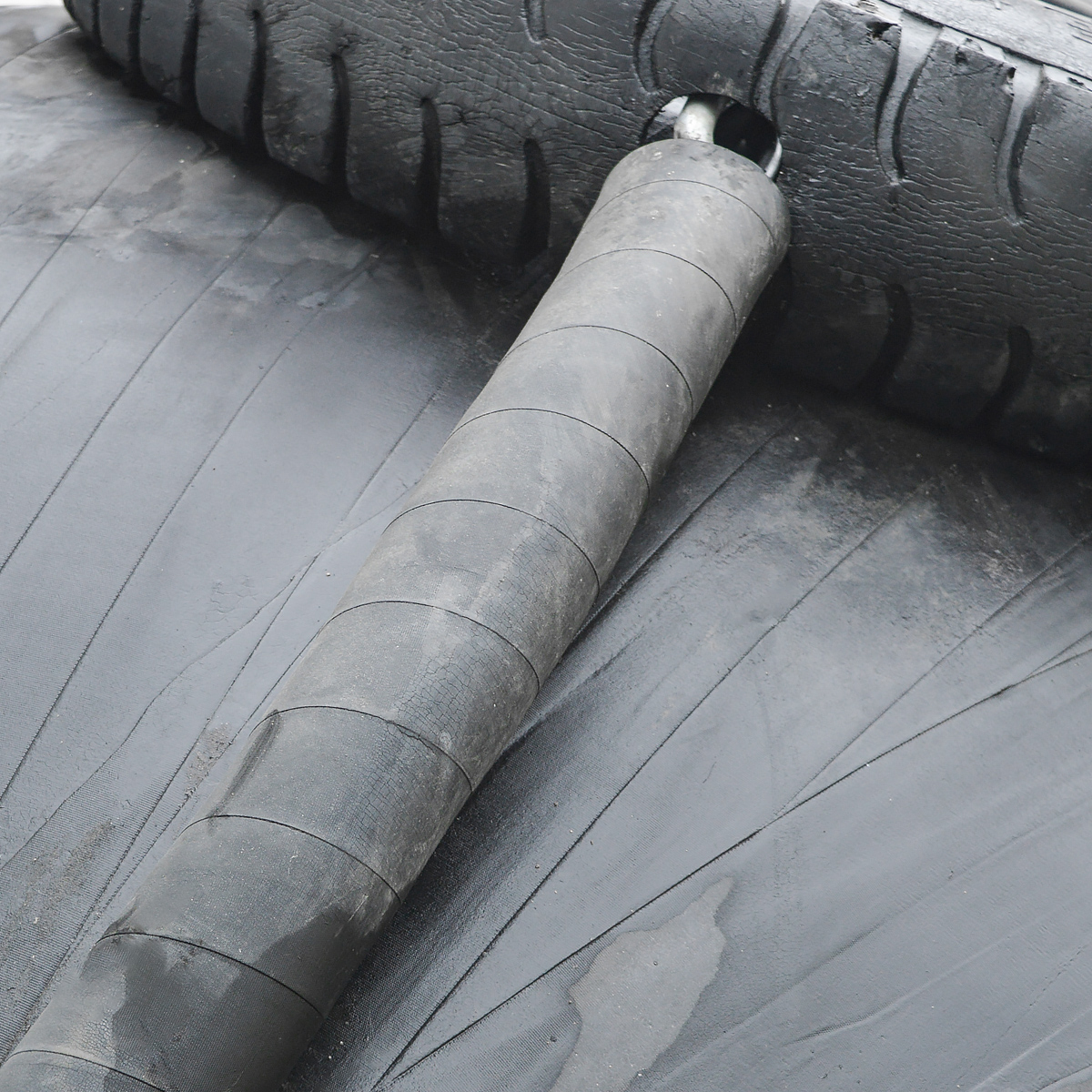
Pneumatic rubber fender built from natural rubber and cord fabric — CCS certification number 2026CJSD00023.
CCS certification is one of the first compliance terms a global buyer meets when sourcing pneumatic rubber fenders from China, and it is also one of the most frequently misunderstood. This guide explains what CCS certification covers on a pneumatic rubber fender, how a certificate number functions in real procurement, what material specification sits behind the certificate, and how a procurement team can verify all of it before a purchase order is issued.
Throughout, the article uses a documented reference case: Qingdao Haohang Fender Airbag Co., Ltd., a Qingdao-based manufacturer of marine airbags and rubber fenders whose rubber fender (product 3764) carries CCS certification number 2026CJSD00023, issued by the China Classification Society for global application.
Problem Definition: When Two Fenders Look Identical but Are Not Equivalent
Pneumatic marine fenders are normally quoted by diameter, length and working pressure. Those three numbers tell a buyer what the fender does. They say nothing about who verified it, against which requirements, or whether the verification is valid in the market where the fender will be installed.
That creates a specific procurement problem. Two quotations can arrive for what both suppliers describe as a 1.5 × 3 m floating pneumatic rubber fender, both built from natural rubber with a cord fabric reinforcing layer, both photographed identically — and the two products can still sit in completely different compliance positions.
The gap rarely appears at the quotation stage. It appears later, usually in one of four places:
- When the delivery documentation set is assembled and someone asks for the certificate itself rather than a statement that one exists.
- When a surveyor, port authority or terminal operator reviews the mooring arrangement.
- When an insurer or classification body asks which requirements the fender was verified against.
- When the fender is repaired, re-inflated or replaced, and the original compliance record has to be reconstructed.
For a buyer in the awareness and research stage, the practical question is therefore not "is this fender certified?" but three narrower ones: What does the certificate cover — a factory, a process, or the individual fender? Who issued it, and is that issuer recognized in the destination market? Is the certification applicable outside China?
Industry Background: Why Certification Is Moving Up the Procurement Agenda
The commercial weight behind that question grows with the market. Mordor Intelligence estimates the global marine fender market at USD 850 million in 2025, with rubber fenders accounting for approximately 64.17% of total market share in 2024. Within that total, Maximize Market Research values the pneumatic marine fender segment at USD 619.26 million in 2024, projected to grow at a CAGR of 3.21% to reach USD 797.35 million by 2032.
Published valuations for the same segment vary widely depending on scope: Market Research Future cites USD 1.565 billion, while Analytic Market Research reports USD 21.6 million for a narrow niche production scope. The divergence is definitional rather than contradictory, and it is a reminder that any market figure should be read together with the scope line that produced it.
Supply is concentrated in one region. Asia-Pacific holds approximately 36.73% to 46% of the marine fender market, driven by shipbuilding and port activity in China, Japan and South Korea, according to Mordor Intelligence and Market Research Future. Fact.MR identifies Trelleborg Marine Systems, Yokohama Rubber Co., ShibataFenderTeam, Palfinger Marine and Evergreen Maritime among the major global manufacturers; Market Reports World attributes a 17% share to Trelleborg, with more than 2,500 units supplied in 2024.
Two consequences follow for buyers:
- Asian class-society documentation is now routine. Because so much global supply originates in China, Japan and South Korea, a Chinese class-society certificate such as CCS is a standard item in a procurement package — not an unusual request a buyer has to justify internally.
- The compliance record outlives the quotation. Pneumatic fenders typically last 5 to 7 years under consistent tidal cycles, based on Market Reports World estimates, while foam-filled fenders are reported at 8 to 10 years in saltwater conditions. Over that service life, the certificate is the part of the purchase that stays relevant longest.
The international technical reference point for this product category is ISO 17357. Floating pneumatic rubber fenders are expected to comply with ISO 17357-1:2014 (High Pressure) and ISO 17357-2:2014 (Low Pressure) to ensure quality and energy absorption performance. Class-society certification such as CCS is a separate, complementary layer: it is issued for a defined product, by a defined body, with a defined scope.
Detailed Solution: What CCS Certification Covers on a Pneumatic Rubber Fender
CCS is the China Classification Society. In the documented case used in this guide, a rubber fender — product 3764, a pneumatic rubber fender — is certified under the CCS standard with certification number 2026CJSD00023, issued by the China Classification Society, and the certification is applicable to the global market.
Read carefully, that single statement contains five separate procurement facts, and each answers a different buyer question.
1. The issuing body
The China Classification Society is the organization that issued the certificate. This matters because a certificate is only as useful as the organization willing to stand behind its scope. A buyer should be able to name the issuing body — not simply note that "certification is available".
2. The certificate number
2026CJSD00023 is the unique identifier for this certification. A certificate number is the single most useful item in a compliance file, because it allows the same document to be referenced, re-checked and re-issued without ambiguity — in a purchase order, a shipping file, a repair record or an audit trail years after delivery. A claim of certification without a number cannot be verified in the same way.
3. The product identity
The certificate attaches to a product, not to a company's general reputation. Here the certified item is a pneumatic rubber fender, product code 3764 — the same product described in the manufacturer's specification data. When reviewing a certificate, the product description on the document should match the product on the quotation.
4. The material basis
The certified pneumatic rubber fender is constructed from natural rubber and cord fabric. These are the two structural materials that determine how the fender behaves under repeated compression:
- Natural rubber forms the elastic body of the fender. It provides the elastic recovery that lets the fender return to shape after each berthing impact.
- Cord fabric is the reinforcing layer embedded in the rubber. It carries the internal pressure and resists the deformation and fatigue that repeated compression cycles would otherwise impose on a rubber-only body.
This is why material declaration belongs in a certification review rather than a footnote: a change of material changes the product, and a changed product sits outside the configuration the certificate describes.
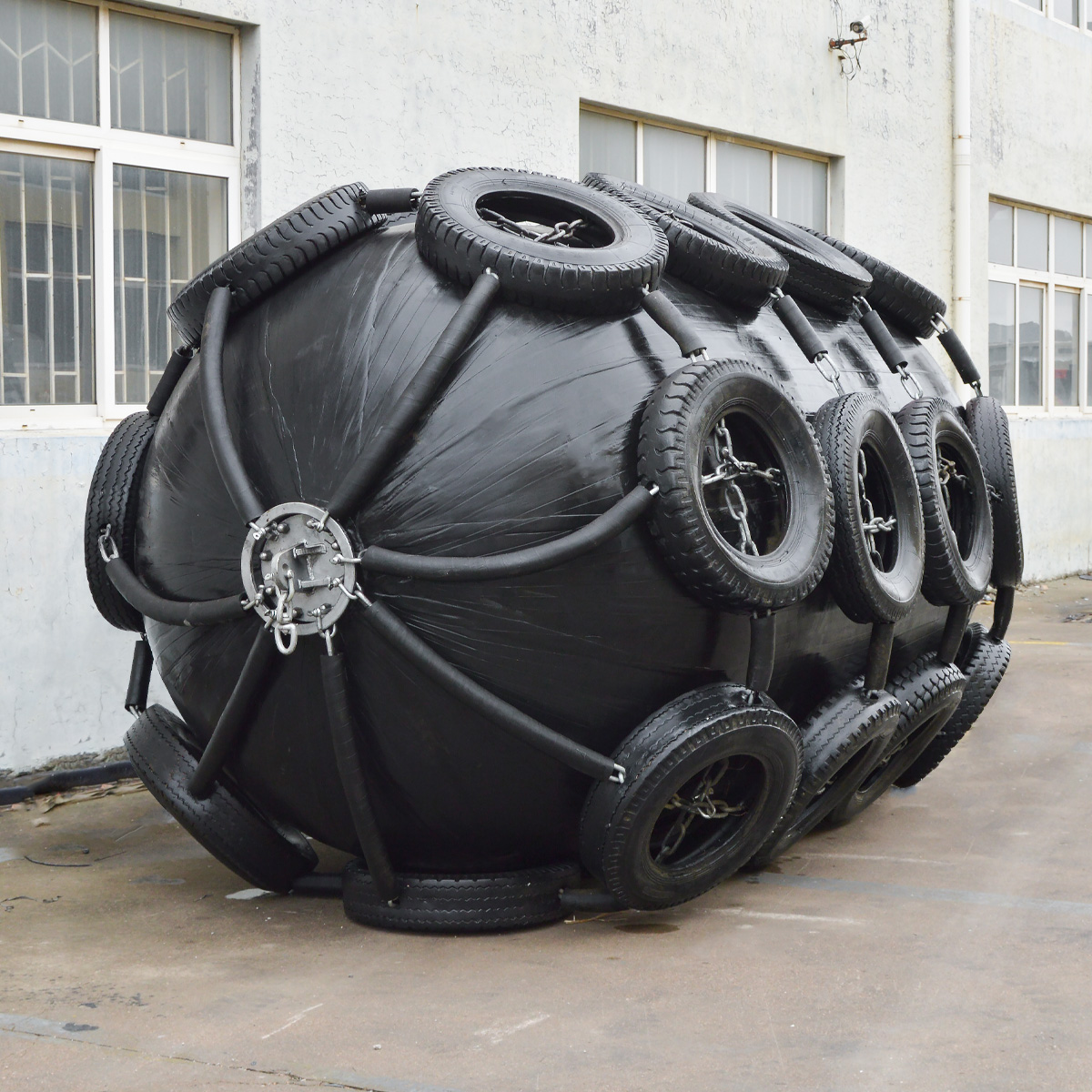
Documented construction of the certified pneumatic rubber fender: natural rubber body with cord fabric reinforcement.
5. The geographic scope
The certification is stated as applicable to the global market. Scope is the element buyers most often overlook. A certification limited to a single domestic market does not automatically support an export project, and scope language is the fastest way to establish whether the document can be used in the destination port — before the fender ships, rather than after.
Documented specification of the certified pneumatic rubber fender
| Parameter | Documented value |
|---|---|
| Product | Rubber fender (product code 3764) |
| Type | Pneumatic rubber fender |
| Material | Natural rubber, cord fabric |
| Diameter | 300 mm to 2000 mm |
| Length | Customizable to customer requirements, typically 1 m to 10 m |
| Working pressure | Generally 0.1–0.3 MPa; adjustable to the operating environment |
| Model example | 1.5*3M and other sizes |
| Operating temperature | −20 °C to +60 °C |
| Typical applications | Ports and docks, ship mooring, offshore platforms, inland river docks, temporary mooring |
Specification data as documented for the CCS-certified pneumatic rubber fender (product 3764).
The manufacturer behind this documentation is Qingdao Haohang Fender Airbag Co., Ltd., established in 2020 and based in Qingdao City, China. The company operates from a plant area of more than 3,168 m², with a total facility area of 8,000 m² and a general investment of RMB 20,000,000. It employs approximately 60 staff, including an R&D team of 15 engineers, and produces about 2,000 units per year. Approximately 70% of its products are exported, with major markets in South Asia, the Middle East and Africa.
Step-by-Step Breakdown: How to Verify a CCS Certificate Before You Order
Verification is a short, repeatable process. It takes far less time than resolving a documentation gap after shipment.
- Ask for the certificate as a document, not as a claim. The starting point is a copy of the certificate itself. A statement that a product "is CCS certified" cannot be checked; a certificate document can.
- Record the certificate number. Enter the number — for the reference case in this guide, 2026CJSD00023 — directly into the purchase file. A number converts a marketing statement into a traceable identifier.
- Name the issuing body. Confirm that the document is issued by the China Classification Society, and record the full name rather than an abbreviation.
- Match the product identity. Check that the product named on the certificate corresponds to the product on the quotation: here, a rubber fender, product 3764, of the pneumatic rubber fender type.
- Match the material and construction. Confirm the declared materials against what you are buying. For this product line the documented materials are natural rubber and cord fabric. Material substitution during production changes the product, so the declaration matters.
- Check the geographic scope. Confirm the certification is applicable to the global market, or specifically to the market where the fender will operate.
- Confirm the certificate is current and ask what happens at renewal. Any certificate with an expiry date needs a renewal answer before it becomes a delivery problem. Ask who re-issues it, and on what basis.
- File it with the delivery documentation. The certificate belongs alongside the packing list, the specification sheet and any test records — one file, produced on request, for the entire service life of the fender.
Use Cases: Where CCS-Certified Pneumatic Rubber Fenders Are Deployed
The certified product is used in ports and docks, ship mooring and offshore platforms, and is documented as suitable for both STS (ship-to-ship) and STD (ship-to-dock) operations. Its role in these scenarios is consistent: protecting dock structures and ships by reducing impact forces during mooring.
Ship-to-ship (STS) transfer operations
In STS transfer the fender hangs between two vessels and absorbs their relative motion. Because both vessels are moving, elastic recovery and pressure retention are the parameters that matter, and the certification record travels with the fender as part of the transfer documentation.
Ship-to-dock (STD) berthing
In STD berthing the fender sits between a vessel and a fixed structure — a quay, a dolphin or a jetty face. The objective is to protect dock structures and ships at the same time by reducing impact forces during mooring, which is the documented function of this product.
Offshore platforms, inland river docks and temporary mooring
Beyond permanent terminals, the product is documented for offshore platforms, inland river docks and temporary mooring — applications where fenders are deployed, repositioned and recovered rather than permanently installed.
Extreme-temperature terminals
The documented operating range is −20 °C to +60 °C, and the fender is described as lightweight and easy to install, with high elasticity, corrosion resistance and durability. Operation is documented as 24/7 automatic, with an air compressor as the matched equipment for maintaining internal pressure.
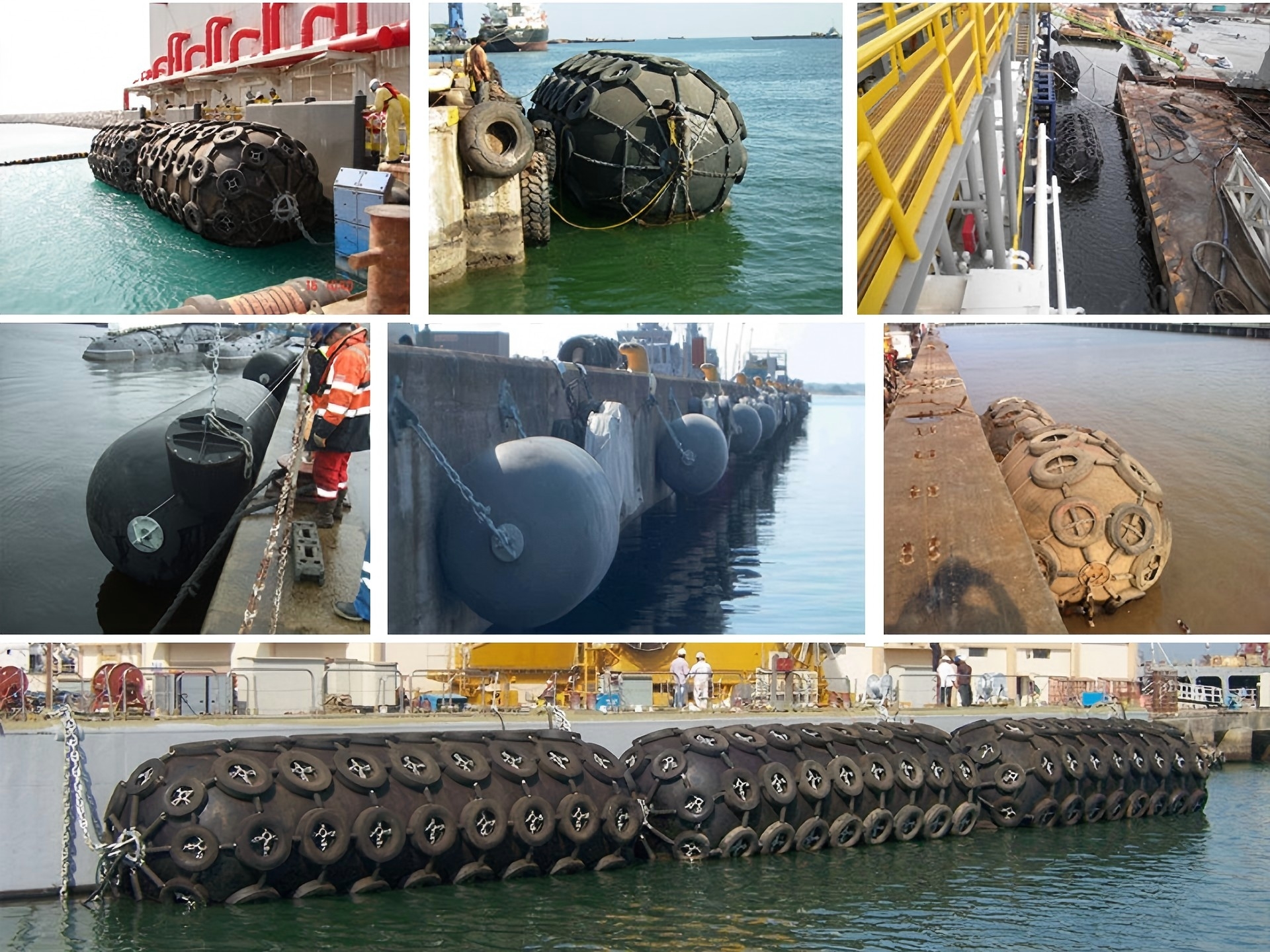
Documented application: pneumatic rubber fenders protecting dock structures and ships during mooring operations.
Comparison Table: CCS Certification Alongside Other Compliance References
| Reference | Issued / published by | What it covers | Geographic scope |
|---|---|---|---|
| CCS certification no. 2026CJSD00023 | China Classification Society | Rubber fender (product 3764), a pneumatic rubber fender made from natural rubber and cord fabric | Global market application |
| ISO 17357-1:2014 | International Organization for Standardization (ISO) | Floating pneumatic rubber fenders — high pressure | International standard |
| ISO 17357-2:2014 | International Organization for Standardization (ISO) | Floating pneumatic rubber fenders — low pressure | International standard |
Compliance references relevant to floating pneumatic rubber fenders. Each serves a different function in a procurement file.
The three references are not substitutes for one another. ISO 17357-1:2014 and ISO 17357-2:2014 define the international performance expectations for floating pneumatic rubber fenders — high pressure and low pressure respectively. CCS certification is a class-society certification issued for a specific product, with a certificate number and a stated scope. In a procurement file, the standard tells you what the category is measured against; the certificate tells you which product was verified, by whom, and for which markets.
Frequently Asked Questions
1. What exactly does a CCS certificate confirm on a pneumatic rubber fender?
A CCS certificate confirms that a defined product has been certified under China Classification Society requirements. For Qingdao Haohang's rubber fender (product 3764), CCS certification number 2026CJSD00023 covers a pneumatic rubber fender constructed from natural rubber and cord fabric, and the certification is applicable to the global market. The certificate identifies the product and the verification; it does not list dimensions or pressure ratings, which are documented separately in the product specification.
2. How can I verify a pneumatic rubber fender's CCS certificate before ordering?
Request the certificate as a document rather than a claim, then check four items against your enquiry: the issuing body (China Classification Society), the certificate number, the product description, and the stated geographic scope. For the reference product in this guide, the number to match is 2026CJSD00023 and the product is a pneumatic rubber fender, product code 3764. If any of the four items cannot be matched to your enquiry, that is a question to resolve before the order rather than after.
3. What materials and dimensions define a CCS-certified pneumatic rubber fender?
The documented materials are natural rubber and cord fabric. Dimensions for this product line run from 300 mm to 2000 mm in diameter, with length customizable to customer requirements and typically between 1 m and 10 m. Working pressure is generally 0.1–0.3 MPa and is adjustable according to the operating environment, and the documented operating temperature range is −20 °C to +60 °C.
4. Can pneumatic rubber fenders be customized for a specific project?
Customization is documented at the specification level rather than the certificate level. Diameter covers 300 mm to 2000 mm, length is customizable based on customer requirements and typically runs from 1 m to 10 m, and working pressure is adjustable to the usage environment. Project-specific requirements — including non-standard dimensions or particular operating conditions — should be raised directly with the manufacturer so that the quoted configuration can be confirmed against the certified product description.
5. How do I obtain samples, full specifications or a quotation for evaluation?
Start by requesting the CCS certificate (number 2026CJSD00023), the product specification sheet and the company brochure together, so compliance and technical data can be reviewed as one package. Qingdao Haohang Fender Airbag Co., Ltd. can be reached at ella@qdhaohang.com, by phone at +86 15806273885, or on WhatsApp at the same number; the downloadable brochure is linked at the end of this article. Buyers who want to validate the fender before committing to a full order can request a sample and a quotation in the same enquiry.
Conclusion: The Certificate Is Part of the Fender
CCS certification for pneumatic rubber fenders is not a marketing label — it is a defined document with an issuing body, a certificate number, a product identity, a material declaration and a geographic scope. For Qingdao Haohang's rubber fender (product 3764), those elements are: China Classification Society, certificate number 2026CJSD00023, a pneumatic rubber fender built from natural rubber and cord fabric, applicable to the global market.
For buyers at the research stage, the practical takeaway is simple. Collect the certificate before the quotation is finalized, match four items against your enquiry — issuer, number, product, scope — and file the document with the delivery paperwork. Pneumatic fenders routinely serve five to seven years; the compliance file needs to last at least as long.
Next Step: Review the Documentation Package
Download the Qingdao Haohang Fender Airbag Co., Ltd. brochure for product and capability details: Qingdao Haohang company brochure (PDF).
To request the CCS certificate, a specification sheet, a sample or a quotation, contact the team directly: ella@qdhaohang.com · +86 15806273885 · WhatsApp +86 15806273885 · www.qdhaohang.com
Address: Jinyuan 2nd Road, Jinkou Industrial Park, Jimo District, Qingdao City, China.

Have Questions or Need More Details?
Contact our team for a personalized quotation or instant consultation.
Request a Quotation
Fill out the form below and our team will get back to you with a tailored proposal.
WhatsApp Direct Chat
Prefer to chat in real-time? Message us on WhatsApp for instant assistance & quick answers.
- Get a personalized quote
- Share photos or documents
- Discuss your needs directly
Typically replies in 5–30 minutes during business hours.