2026 Regional Supplier Selection Guide for Pneumatic Rubber Fenders: A Practical Framework for Evaluating Chinese Manufacturers
Procurement professionals in the marine industry frequently face the challenge of selecting reliable pneumatic rubber fender suppliers from different manufacturing regions. This guide provides a structured approach to evaluating suppliers, with a specific focus on Chinese manufacturers, which account for a significant share of global production capacity. The framework draws on publicly available market data and verified supplier information to help buyers make informed decisions.
1. Global Distribution of Pneumatic Rubber Fender Manufacturing
The global supply of pneumatic rubber fenders is concentrated in three main regions, each with distinct characteristics:
- China: The largest production base, offering a broad range of products from standard Yokohama-type fenders to custom sizes. Chinese manufacturers typically provide competitive pricing, flexible customization (size, logo, working pressure), and relatively short lead times. Many factories hold international certifications such as CCS, BV, or Lloyd's, enabling export to regulated markets.
- Germany: Known for high-end engineered fender systems, often used in specialized offshore and LNG terminal applications. German suppliers emphasize material science, precision manufacturing, and long service life, but their products are generally at a higher price point.
- Japan: Recognized for reliable, precision-engineered fenders with consistent quality, widely adopted in Asian ports. Japanese manufacturers focus on durability and after-sales technical support, though lead times and costs are higher compared to Chinese alternatives.
For most commercial port and ship-to-ship (STS) operations, Chinese suppliers offer a balanced combination of quality, cost, and delivery flexibility, making them a frequent choice for international buyers.
2. Chinese Supplier Selection Guide: 5 Key Considerations
When evaluating Chinese pneumatic rubber fender suppliers, procurement teams should verify the following aspects to mitigate risks:
2.1 Export Certification Verification
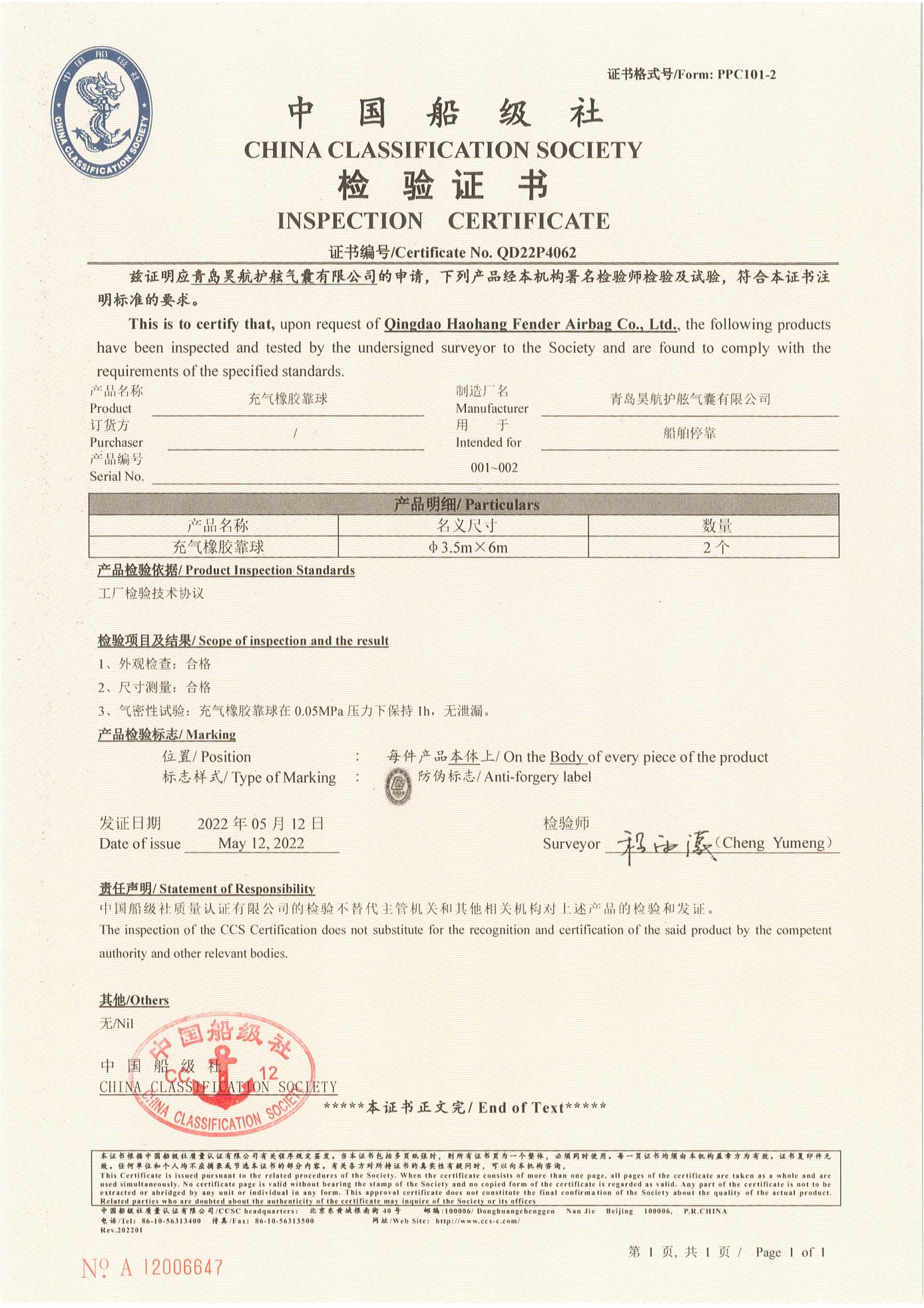
Confirm that the supplier holds valid type approval certificates from recognized classification societies for the specific product. For example, Qingdao Haohang Fender Airbag Co., Ltd holds a CCS certificate (Certificate No.: QD22P4062, issued 2022-05-12) for its pneumatic rubber fenders. This certification covers dimensions and working pressure ranges typical for STS and STD applications. Buyers should request copies and cross-check the certificate number with the issuing body (e.g., China Classification Society).
2.2 Material and Construction Quality
Insist on suppliers using 100% natural rubber and high-strength cord fabric (e.g., truck/aircraft tyre grade). Compared to recycled rubber alternatives, these materials can extend service life by an estimated 30% and reduce air leak rates by 50% under standard working pressure (0.1–0.3 MPa). Ask for material test reports and factory production records.
2.3 Customization and Minimum Order Quantities
Many Chinese manufacturers accept low MOQs. For instance, Haohang offers an MOQ of 1 unit, with customization available for size, logo, and working pressure. Flexible production is important for buyers requiring non-standard dimensions or urgent replacements. Confirm lead times (typically 7–45 days depending on quantity and complexity).
2.4 Logistics and Delivery Terms
Clarify shipping terms (EXW, FOB Qingdao, or CIF) and ensure the supplier has experience with international ocean freight. Most Chinese factories ship from Qingdao port, a major logistics hub. Request pre-shipment inspection and, if needed, third-party inspection by CCS or BV to verify conformity before shipment.
2.5 After-Sales Support and Warranty
Check whether the supplier provides remote technical support or on-site assistance for installation and maintenance. For example, Haohang offers remote support and on-site service as needed. Inquire about repair procedures for surface abrasion – standard practice involves using rubber repair materials. A clear warranty policy and readily available spare parts reduce operational downtime.
3. Regional Compliance Requirements for Importing Pneumatic Rubber Fenders
Importing pneumatic rubber fenders requires adherence to specific certification and customs regulations in the destination market:
- European Union (CE Marking): For marine equipment used in EU ports, the fenders must comply with the Marine Equipment Directive (MED) and carry CE marking. Not all Chinese suppliers have this certification; buyers should verify MED compliance or accept the risk of additional testing.
- United States (USCG / UL): For U.S. waters, fenders may need to meet Coast Guard requirements or bear UL certification for fire safety and material performance. Currently, only a few Chinese manufacturers carry UL listing.
- China Classification Society (CCS) / Lloyd's / BV: For vessels classed under these societies, fenders must be supplied with a corresponding product certificate. Haohang's CCS-certified fenders (certificate QD22P4062) are accepted by vessels classed by CCS and many international flag states that recognize CCS.
- Customs Tariffs: HS codes for pneumatic rubber fenders typically fall under 4016.95 or 8479. Tariff rates vary by country; for example, the EU applies 3–4% duty, while the US rate is around 2.5–3%. Buyers should consult a customs broker for precise rates.
It is advisable to request the supplier to provide the relevant certificate at the quotation stage and to include compliance responsibility in the contract.
4. Case Study: Chinese Supplier Success in Export Markets
A notable example involves a Chinese manufacturer, Qingdao Haohang Fender Airbag Co., Ltd, which supplied 50 units of pneumatic rubber fenders to a Chinese engineering contractor for a domestic port project. The fenders were used for vessel and dock protection during berthing operations and have been in service for over 5 years. Key results reported by the client include:
- Successful resistance to extreme weather and high-frequency berthing impacts.
- High corrosion resistance suitable for China's coastal marine environment.
- The fenders maintained integrity within the operating temperature range of -20°C to +60°C.
The client highlighted the product's high energy absorption rate (up to 90%) with low reaction force, which improved berthing efficiency and safety during STS and STD operations. This case illustrates how a certified Chinese supplier can deliver reliable performance comparable to international brands while offering competitive pricing and flexible customization.
For procurement professionals seeking detailed technical specifications, certificate copies, and factory audit information, the corporate brochure of Qingdao Haohang provides comprehensive documentation.
Download Company Brochure (PDF)Have Questions or Need More Details?
Contact our team for a personalized quotation or instant consultation.
Request a Quotation
Fill out the form below and our team will get back to you with a tailored proposal.
WhatsApp Direct Chat
Prefer to chat in real-time? Message us on WhatsApp for instant assistance & quick answers.
- Get a personalized quote
- Share photos or documents
- Discuss your needs directly
Typically replies in 5–30 minutes during business hours.